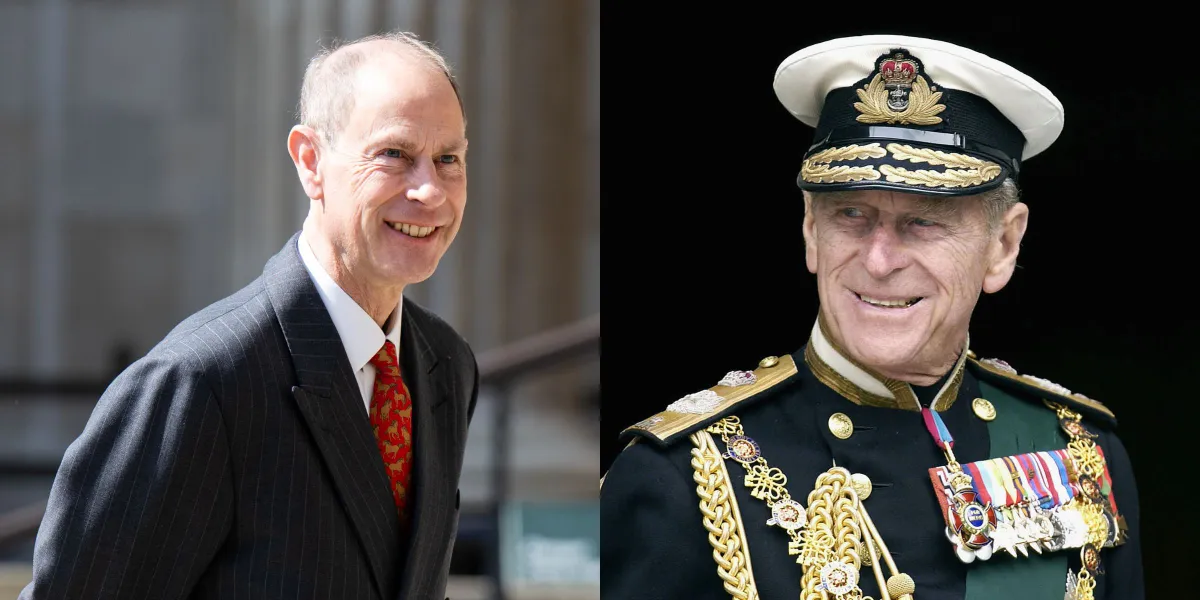
There is a moment, caught on camera, where you have to look twice.
On 21st April 2026, Prince Edward, Duke of Edinburgh, and his wife Sophie, Duchess of Edinburgh, arrived at the British Museum in London to view the final design for the national memorial to the late Queen Elizabeth II — a deeply poignant occasion marking what would have been Her Majesty’s 100th birthday.

Sophie, Duchess of Edinburgh and Prince Edward, Duke of Edinburgh arrive at the British Museum on the 100th anniversary of the birth of Queen Elizabeth II on 21 April 2026 in London, England. | Source: Getty Images
Edward cut a smart, composed figure in a dark pinstripe suit and a bold red tie, walking with his hands clasped behind his back as he and Sophie made their way up the museum’s grand steps.
And that posture — quiet, upright, hands laced behind the body — stopped royal fans in their tracks. To many, it was unmistakably familiar: the very same stance that Edward’s late father, Prince Philip, had struck so many times before him.

Sophie, Duchess of Edinburgh and Prince Edward, Duke of Edinburgh arrive at the British Museum on the 100th anniversary of the birth of Queen Elizabeth II on 21 April 2026 in London, England. | Source: Getty Images
Celebrity psychic and body language expert Inbaal Honigman has weighed in, offering a compelling explanation for why the likeness feels so uncanny. According to Inbaal, much of it traces back to childhood.
Children, she explains, naturally mirror their parents — copying their movements, their postures, and even the way they hold themselves when they want to appear attentive or composed.

Sophie, Duchess of Edinburgh and Prince Edward, Duke of Edinburgh arrive at the British Museum on the 100th anniversary of the birth of Queen Elizabeth II on 21 April 2026 in London, England. | Source: Getty Images
Over time, those learned behaviours become instinctive, carrying through into adulthood without the person even realising it. But there is also something more structural at play.
“As the late Prince Phillip and his son Edward are both tall and slim, they’d naturally gravitate towards the same types of moves and poses, which makes their resemblance even more striking. And, of course, there’s the matter of personality and characteristics,” Inbaal noted.

Prince Edward, Duke of Edinburgh arrives at the British Museum on the 100th anniversary of the birth of Queen Elizabeth II on 21 April 2026 in London, England. | Source: Getty Images
Look at the side-by-side photographs and it becomes difficult to argue otherwise. The same lean frame, the same composed gaze, the same instinct to stand with hands clasped at the back — a posture that Inbaal reads with particular interest.
“Edward’s hands, which are laced behind his back, are formal yet candid. When the arms are behind the body, as is the case with Edward and Phillip, this is the body language of an honest, candid individual,” she said.

Prince Edward, then-Earl of Wessex and Prince Philp, then-Duke of Edinburgh watch the flypast over the Mall of British and US World War II aircraft from the balcony of Buckingham Palace on National Commemoration Day on 10 July 2005 in London, England. | Source: Getty Images
According to Inbaal, holding the hands behind the body — rather than letting the arms dangle loosely at the sides — signals restraint, a comfort with formality, and an ease with tradition. It is a pose that projects dignity without rigidity.
She also noted that Edward’s slight forward lean in photographs reads as sociable and warm — an eagerness to connect, rather than a desire to keep distance.

Queen Elizabeth II, Prince Philip, then-Duke of Edinburgh and Prince Edward, then-Earl of Wessex attend the launch of The Queen’s Baton Relay for the XXI Commonwealth Games being held on the Gold Coast in 2018 at Buckingham Palace on 13 March 2017 in London, England. | Source: Getty Images
“This jovial, candid, yet slightly formal body language suits Edward’s character, and also Philip’s,” Inbaal concluded.
Sophie, for her part, was radiant beside her husband — dressed in a flowing cream Gabriela Hearst equestrian print dress that many royal fans saw as a touching nod to the late Queen’s love of equestrianism.

Sophie, Duchess of Edinburgh and Prince Edward, Duke of Edinburgh arrive at the British Museum on the 100th anniversary of the birth of Queen Elizabeth II on 21 April 2026 in London, England. | Source: Getty Images
The couple were at the British Museum to see the chosen design for the Queen Elizabeth II national memorial, a visit that carried obvious emotional weight for Edward, who was his mother’s youngest child.
The visit was a reminder of how much Edward has stepped into his own in recent years — quietly, steadily, and, as it turns out, very much in the image of his father.

Prince Philip is photographed with his sons, Prince Edward and Andrew Mountbatten-Windsor, during their Summer holidays in August 1983 in Scotland. | Source: Getty Images
And it seems the Philip genes don’t end with Edward. Edwad’s son James is growing into his own striking resemblance — and royal watchers have taken notice.
Once shielded from the spotlight, the newly titled Earl of Wessex has officially come of age — and fans are swooning over his transformation from royal toddler to polished young gentleman. See his evolution through the years below.
He was once dubbed the “Hidden Prince” — a quiet, unassuming royal raised far from the flashing cameras and media frenzy that so often consume the Firm.
But now, James Mountbatten-Windsor, the only son of Prince Edward and Sophie, Duchess of Edinburgh, has officially stepped into the royal spotlight. The young royal turned 18 on Wednesday, 17 December 2025, sparking a flurry of fanfare, fawning comments, and curiosity about what’s next.
The milestone birthday arrives just months after James inherited his father’s secondary title, Earl of Wessex, following Edward’s elevation to Duke of Edinburgh — a title previously held by the late Prince Philip, James’s grandfather.