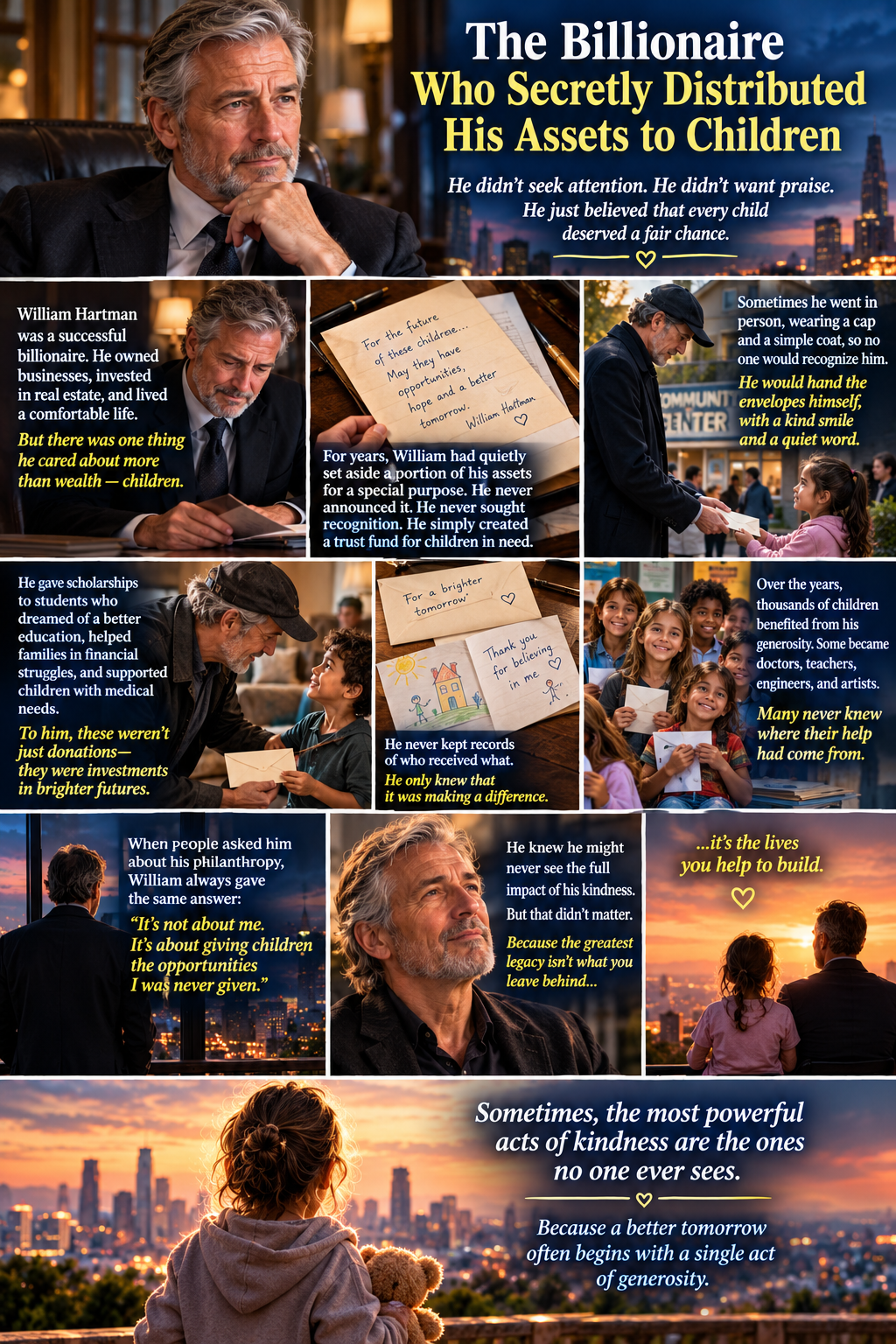
The Billionaire Who Secretly Distributed His Assets to Children
A Heartwarming Story of Hidden Generosity, Second Chances, and a Legacy That Changed Thousands of Lives
Chapter 1: The Billionaire Nobody Truly Knew
William Hartman had everything most people dreamed of having.
At seventy years old, he owned several successful companies, luxury properties, hotels, and valuable investments. His mansion stood on a hill overlooking the city, with enormous windows, beautiful gardens, and a driveway lined with trees.
Business magazines called him a genius. Wealthy investors admired his judgment. Politicians wanted his attention, and business leaders competed for invitations to his private dinners.
Yet, despite his extraordinary fortune, William had one unusual habit.
He rarely talked about his money.
He never enjoyed showing off his wealth, and he disliked people who measured someone’s worth by the size of their bank account. Whenever journalists asked him about his greatest achievement, he usually spoke about his businesses.
But there was a secret he had protected for nearly twenty years.
Every month, William quietly set aside a portion of his income to help children whose families could not afford school fees, medical treatment, or even the basic necessities of life.
He paid for school uniforms, bought books, supported struggling parents, and funded scholarships for talented students.
He did not want his name printed on buildings. He did not want photographs taken with grateful families. In many cases, the children he helped never learned who had paid their bills.
To William, kindness was not a performance.
It was a responsibility.
And he had a personal reason for believing that every child deserved a chance.
Chapter 2: The Boy Who Changed His Life
William had not always been wealthy.
When he was twelve, his father died unexpectedly, leaving his mother to raise three children alone. She worked long hours cleaning offices and washing clothes for other families.
William remembered sitting at the kitchen table one winter evening while his mother counted the little money they had left.
His school had announced that students who could not pay their fees would have to stay home until their accounts were settled.
William had worked hard that year. His teachers believed he had the ability to become an engineer, but he feared his education would end before he had a chance to prove himself.
The next morning, his mother received an envelope containing enough money to cover his school fees and purchase his books.
There was no signature.
There was no explanation.
Inside, someone had written just one sentence:
“Your future should not be decided by the hardships you were born into.”
William never discovered who had sent it.
But he never forgot those words.
He finished school, earned a scholarship to university, and eventually built a business from a tiny rented office. His first company nearly failed twice. He lost investors, faced enormous debts, and spent sleepless nights wondering whether he would ever succeed.
Then, slowly, his circumstances changed.
One contract led to another. His company expanded, and his investments began to grow. After decades of hard work, the boy who had once worried about school fees became one of the richest men in the country.
Yet the anonymous envelope remained in his desk.
It reminded him that one person’s kindness could change the direction of another person’s life.
William decided that if he ever had enough money, he would become that person for someone else.
Chapter 3: The Secret Fund
When William turned fifty, he established a private charitable trust called the Hartman Children’s Opportunity Fund.
He instructed his lawyers to structure it carefully, with independent oversight, clear eligibility requirements, and financial records that would protect the children and families receiving assistance.
The fund supported children from low-income households.
Some needed scholarships to attend university. Others needed urgent medical care. Some had lost their parents, while others lived with grandparents who could barely afford food and electricity.
William refused to divide children into those who deserved help and those who did not.
He wanted the fund to offer opportunities rather than simply hand out money.
One part paid tuition and educational expenses. Another supported children’s medical needs through qualified providers. A third helped families facing temporary financial emergencies.
William also invested in community centers where children could receive tutoring, learn computer skills, and explore careers they might never have imagined possible.
He visited some of these centers himself.
Sometimes he arrived wearing a plain jacket and an ordinary cap, introducing himself as a volunteer. He listened while children talked about becoming teachers, doctors, artists, scientists, and business owners.
One afternoon, a little girl approached him after a reading session.
“Sir, why do you help us?” she asked.
William smiled.
“Because somebody helped me when I was young.”
“Who was it?”
He looked at the books in her arms and thought of the unsigned envelope that had changed his life.
“I wish I knew,” he replied. “But perhaps I can pass that kindness on.”
The girl considered his answer carefully.
Then she hugged her books and ran back to her friends.
William watched her go, feeling that familiar warmth in his heart.
For a moment, he was twelve years old again, sitting beside his mother at their old kitchen table.
Chapter 4: The Decision That Shocked His Family
As William grew older, he began thinking more seriously about what would happen to his fortune after his death.
His two adult children, Daniel and Victoria, had grown up surrounded by privilege. They attended prestigious schools, traveled around the world, and inherited opportunities William had never possessed as a boy.
He loved them both.
He had also spent years teaching them that wealth brought responsibility.
But they did not always agree with him.
Daniel believed the family fortune should remain within the family. Victoria thought the charitable fund had grown too large and that William was giving away money that could eventually belong to his grandchildren.
Their disagreements became more intense when William invited his lawyers to review his estate plan.
At a family dinner, Daniel finally asked the question everyone had been avoiding.
“Father, how much of your estate are you planning to give away?”
William placed his fork beside his plate.
“Enough to make a lasting difference.”
Daniel frowned.
“That isn’t an answer.”
“It is the answer you need,” William replied. “I have worked for my money, but that doesn’t mean every dollar must remain with me or my descendants forever.”
Victoria leaned forward.
“You’re talking about giving away assets worth hundreds of millions. What will people think?”
William looked at his daughter with sadness rather than anger.
“I am less concerned about what people think of me than about what happens to children who never receive a fair chance.”
The room became silent.
His children left dinner frustrated, convinced their father was making an emotional decision.
William understood their concerns, but he had already made up his mind.
He would not distribute his wealth carelessly, and he would not leave vulnerable children dependent on his personal generosity. He would create a lasting system that could continue helping them long after he was gone.
His lawyers began preparing a comprehensive plan involving charitable trusts, scholarships, community programs, and carefully managed investments.
The plan would preserve the fund’s long-term financial health while ensuring that William’s family retained only the assets he intended for them.
For the first time, his fortune had a purpose beyond growing larger.
It had a future.
Chapter 5: The Little Girl With the Blue Backpack
Several months later, William visited one of the community centers supported by his fund.
He found a group of children working on a school project. Most were laughing and sharing colored pencils, but one girl sat quietly at a table near the window.
Her name was Sophie. She was ten years old and carried a faded blue backpack that had been repaired several times.
William sat across from her.
“What are you working on?” he asked.
“A picture of my future,” she answered.
She showed him a drawing of a hospital, a row of trees, and a small house with flowers in front.
“I want to become a doctor,” she explained. “My little brother gets sick a lot, and sometimes my mother worries because medicine costs too much.”
William studied the drawing.
“Why did you put the trees beside the hospital?”
Sophie smiled shyly.
“Because people need somewhere peaceful to sit when they are worried.”
William was touched by her answer.
He learned that Sophie’s mother worked two jobs and that Sophie often helped care for her younger brother after school. The family had never asked the fund for special treatment. They had simply applied through the center’s ordinary scholarship program.
William made no promises that afternoon.
Instead, he asked the center’s staff to review the family’s eligibility for educational support and connect them with appropriate community services.
Several weeks later, Sophie received a scholarship covering her school expenses, along with tutoring and access to a science program.
When she learned that she could continue studying without placing additional pressure on her mother, she ran home with the letter clutched in her hands.
Her mother cried when she read it.
They never knew that the quiet man who had spoken with Sophie at the center was the billionaire responsible for the fund.
William preferred it that way.
He did not need Sophie to remember his face.
He only hoped that one day she would remember the person she wanted to become.
Chapter 6: The Secret Is Revealed
William’s secret might have remained hidden for years if not for a financial reporter named Emily Carter.
Emily had spent months investigating the Hartman Children’s Opportunity Fund after discovering that several university students from struggling backgrounds had received anonymous scholarships.
Her investigation revealed an extraordinary pattern.
Over nearly two decades, the fund had supported thousands of children and families through education, healthcare assistance, and community programs.
The money had come from a private charitable trust connected to William Hartman.
Emily requested an interview.
At first, William declined.
“I am not the story,” he told his assistant. “The children are.”
But Emily explained that revealing the fund’s work could encourage other wealthy individuals to support similar programs.
After careful consideration, William agreed to meet her.
During the interview, Emily asked him why he had kept the donations secret for so long.
William looked out at the city through his office window.
“When people know a rich person is giving away money, they sometimes focus on the rich person,” he said. “They write about his generosity, his lifestyle, and his reputation. But I want people to ask a different question.”
“What question is that?” Emily asked.
“How many talented children are we overlooking simply because their families cannot afford to support their dreams?”
Emily paused before asking her final question.
“Mr. Hartman, do you regret giving away so much of your fortune?”
William smiled.
“I regret that I cannot help everyone. I have never regretted helping someone.”
When the article was published, it attracted national attention.
People were surprised by the scale of William’s generosity. Former scholarship recipients began sharing their experiences, and families spoke about the opportunities that had changed their lives.
For the first time, the public learned the story behind the mysterious fund.
But the greatest surprise was still to come.
Chapter 7: The Announcement
On a bright spring morning, William invited his family, lawyers, foundation trustees, and several former scholarship recipients to a community center.
Daniel and Victoria arrived expecting another discussion about the estate.
Instead, they found a room filled with students, teachers, parents, and graduates.
William stood at the front beside a large screen displaying the words:
A Future Without Limits.
He explained that his estate plan would direct a substantial portion of his wealth toward a permanent charitable foundation, subject to the legal documents and safeguards established by his advisers.
The assets would not be handed out randomly. They would be managed responsibly, with professional oversight, transparent reporting, and programs designed to help children build independent futures.
His remaining personal estate would be distributed according to his will and other lawful arrangements.
“This is not about punishing my family,” William said, looking at Daniel and Victoria. “It is about deciding what my life’s work should accomplish.”
He invited several former beneficiaries to speak.
A young woman described becoming the first person in her family to graduate from university. A young man explained how medical assistance had helped him continue his education while his family faced hardship. A teacher spoke about students who had discovered their abilities because someone had given them access to books, computers, and patient guidance.
Then Sophie, now older and studying in a science program, stepped forward with a piece of paper.
It was a drawing of a hospital surrounded by trees.
She had kept the original picture from the day she met William.
“I used to think my dream was too expensive,” she said. “Now I know I can work toward it.”
William lowered his head for a moment, overcome with emotion.
Daniel watched the students. Victoria looked at the parents sitting together in the front row.
For the first time, they began to understand that their father was not simply giving money away.
He was creating opportunities that would otherwise never exist.
After the event, Daniel approached him.
“I still don’t agree with every decision,” he admitted. “But I understand why you’re doing it now.”
William placed a hand on his son’s shoulder.
“You don’t have to agree with everything I do. Just remember that having more than someone else does not make you more valuable than they are.”
Victoria joined them, quietly wiping away a tear.
“Perhaps we could help with the foundation,” she suggested.
William smiled.
“That would mean more to me than you know.”
Chapter 8: The Greatest Part of His Fortune
Years passed.
William’s health gradually weakened, and he eventually stepped back from the daily management of his companies.
The foundation continued operating under independent leadership, supported by investments and charitable assets established through his estate plan.
Scholarships helped students enter universities and vocational programs. Community partnerships expanded educational resources. Families received assistance during difficult periods, and children gained access to opportunities that had once seemed impossibly far away.
Sophie continued pursuing her dream of becoming a doctor.
Daniel began supporting the foundation’s educational programs, while Victoria helped develop partnerships with schools and community organizations.
Neither of them became perfect overnight, but both learned that generosity could be more meaningful when it was guided by responsibility rather than recognition.
One afternoon, William returned to the community center where he had first met Sophie.
She was there to speak with younger students about science and education.
When she saw him, she hurried over and embraced him.
“Mr. Hartman, do you remember my drawing?”
“Of course,” he said. “The hospital with the trees.”
She laughed.
“I kept it all these years.”
William looked around the room. Children were reading, building small science projects, and talking excitedly about their futures.
He had spent much of his life building companies and increasing his fortune.
But standing there, surrounded by children who finally had room to dream, he realized that his most important achievement had never appeared on a financial statement.
It was visible in the confidence of a child who believed she could become a doctor.
It was visible in a student who could attend university without abandoning the hope of graduating.
It was visible in parents who no longer felt they had to face every hardship alone.
And it was visible in his own children, who were beginning to understand that a meaningful legacy could be shared with people they would never meet.
William sat beside the window and watched the afternoon sunlight fall across the tables.
For the first time in many years, he felt completely at peace.
He had not given away his life’s work.
He had given it a purpose.
Epilogue: What William Left Behind
William Hartman eventually passed away peacefully, surrounded by his family.
His funeral attracted business leaders, public figures, former employees, and many people who had benefited from his charitable work.
But the most moving tribute came from the children and former students who gathered outside the community center.
They brought letters, drawings, and small cards expressing their gratitude.
One message, written in a child’s careful handwriting, said:
“Thank you for believing in my future before I knew how to believe in it myself.”
That sentence was placed beside William’s photograph at the memorial.
His fortune had helped build companies, purchase properties, and create financial security.
Yet the most enduring part of his legacy was something no market could measure.
It was the chance he had given to people who might otherwise have been forgotten.
And somewhere, years later, a young doctor named Sophie stood beneath the trees outside a hospital, watching a frightened child hold her mother’s hand.
She knelt beside the child and spoke gently.
“You have a future,” she said. “And there are people who want to help you reach it.”
The little girl looked up at her.
“Why are you helping me?”
Sophie smiled, remembering the quiet billionaire who had once listened to her dreams.
“Because someone helped me when I needed it most.”
And in that moment, William’s kindness continued—not through his money alone, but through the lives it had changed.
The greatest fortune is not the wealth we keep. It is the hope we leave behind. ❤️