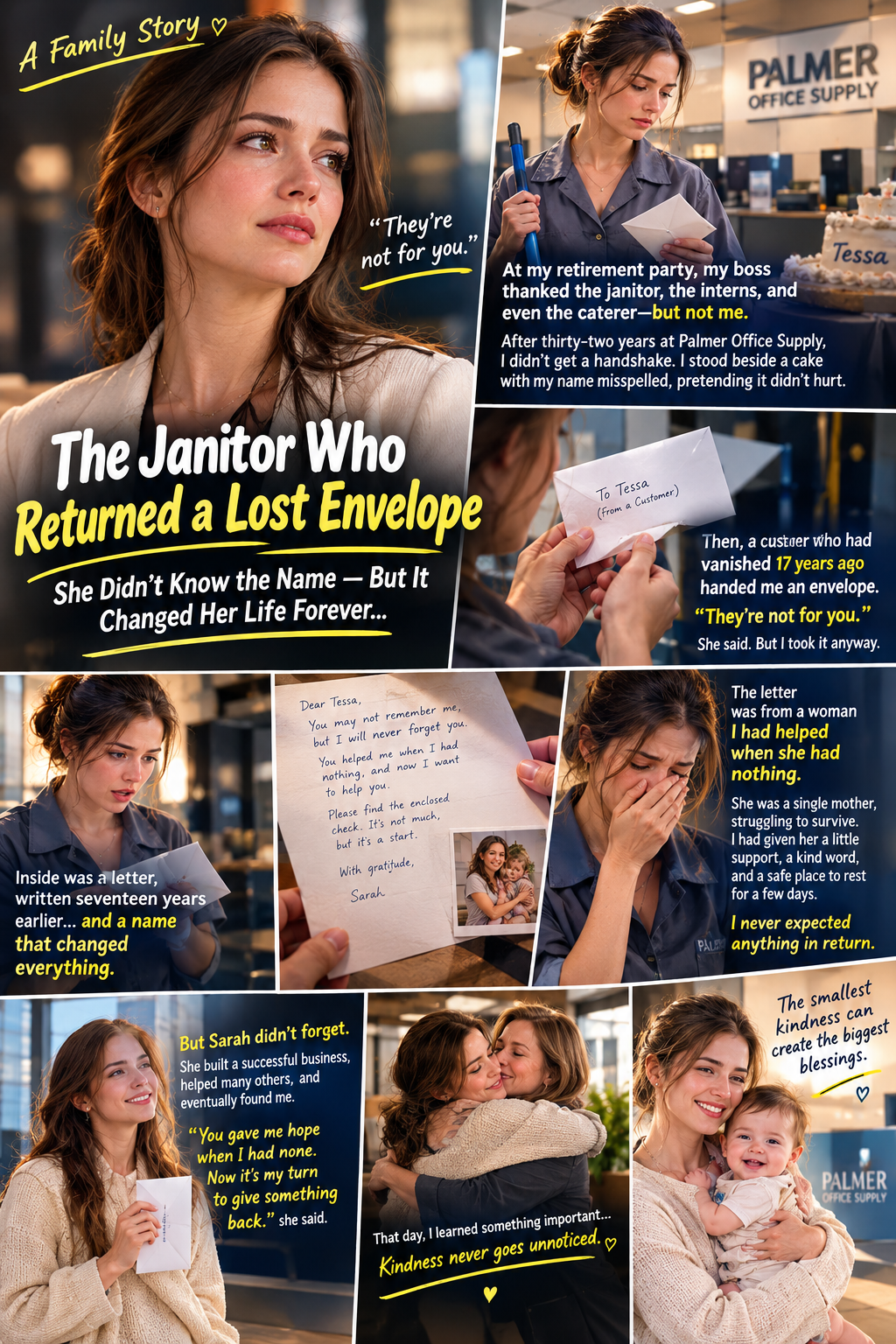
After thirty-two years of working at Palmer Office Supply, I thought my retirement party would be a day I would remember for the rest of my life.
My name is Tessa Morgan. I was fifty-eight years old, and for more than three decades, I had helped keep Palmer Office Supply running. I had cleaned the floors before the employees arrived, stayed late after important meetings, prepared conference rooms, and helped customers who needed directions or a little kindness.
I had never expected to become rich from my job.
All I wanted was to retire with enough savings to live comfortably, spend more time with my grandchildren, and finally take the vacation I had postponed for years.
On my last Friday, the company organized a small retirement party in the conference room.
There was a white cake, a few balloons, and a table covered with sandwiches.
I wore my best blue dress. I even bought a new pair of shoes for the occasion.
My daughter had told me that morning, “Mom, thirty-two years is a lifetime. You deserve to be celebrated.”
I believed her.
At three o’clock, my boss, Martin Palmer, stood beside the cake.
“Today, we recognize the people who make this company successful,” he announced.
He thanked the janitor who had worked there for six months. He thanked two interns who had joined the previous summer. He even thanked the catering company for bringing lunch.
Everyone clapped.
Then Martin looked at his watch.
“Well, I think that covers everything. Enjoy the cake, everyone.”
I stood beside the table, waiting.
Perhaps he had forgotten my name.
Perhaps he planned to thank me privately.
Perhaps someone would mention the thirty-two years I had spent helping his company grow.
But nobody did.
The receptionist, a young woman named Tessa—yes, another Tessa—noticed my expression and quickly corrected herself.
Her real name was Teresa, but everyone called her Tessa.
She approached me quietly.
“I’m sorry,” she whispered. “That wasn’t right.”
I forced a smile.
“It’s all right, sweetheart.”
But it wasn’t.
I stood beside a cake with my name misspelled on it, pretending that I wasn’t hurt.
After thirty-two years, I had become so accustomed to being overlooked that I almost felt embarrassed for wanting to be remembered.
Then Teresa returned from the reception area, pushing a small cart stacked with hundreds of envelopes.
She looked frightened.
“Martin,” she said, “these arrived for Tessa Morgan.”
My boss frowned.
“What are you talking about?”
“Letters from customers. Some of them have been sending messages for years. They heard she was retiring.”
Martin walked over and examined the envelopes.
Then he shook his head.
“Those aren’t for her. Put them in the mailroom.”
Teresa held her ground.
“But they have her name on them.”
Martin lowered his voice.
“I said they’re not for her.”
He turned away.
Teresa looked at me helplessly.
Then she reached into her pocket and pulled out one final envelope.
“This one was delivered separately,” she whispered. “It has a return address from a woman who disappeared from our customer records seventeen years ago.”
She handed it to me.
The moment I saw the name written beneath the return address, my hands began to tremble.
Sarah Whitmore.
I hadn’t heard that name in seventeen years.
And I had never expected to hear it again.
Chapter 2: The Girl Who Came Into the Store Crying
Seventeen years earlier, I had been working an afternoon shift when a young woman entered Palmer Office Supply.
She looked about twenty-three. Her coat was too thin for the weather, her hair was tangled, and she carried a sleeping baby wrapped in a faded blanket.
She stood in the stationery aisle for nearly twenty minutes, holding a small notebook.
Eventually, she approached the counter.
“Excuse me,” she said softly. “Could you tell me how much these notebooks cost?”
I checked the price.
“Three dollars each.”
She looked into her purse.
Then she put the notebook back on the shelf.
“Thank you.”
She turned to leave, but something about her expression made me stop her.
“Sweetheart, are you all right?”
She immediately began crying.
I guided her to a chair in the small break area near the back of the store and brought her a glass of water.
For a long time, she couldn’t speak.
Finally, she told me her name was Sarah. She had recently left an abusive relationship and was trying to find work while caring for her infant daughter.
She had very little money and nowhere permanent to stay.
She had come into the store because she needed paper and envelopes to apply for jobs, but even three dollars felt like too much.
I knew what it was like to struggle.
When I was twenty-four, my husband had died unexpectedly, leaving me with a young daughter and a mountain of bills. I had worked two jobs for years to keep a roof over our heads.
I remembered the shame of standing in a grocery store calculating whether I could afford milk and bread.
I remembered how a stranger had once paid for my groceries without making me feel small.
I never forgot that kindness.
So I told Sarah to wait.
I bought her two notebooks, a pack of envelopes, pens, and a small folder for her job applications.
Then I called a local family support center and asked whether they could help her find temporary accommodation.
Sarah stared at me.
“Why are you doing this?”
“Because someone helped me once,” I replied. “And I promised myself that if I ever could, I would help someone else.”
She held her baby closer.
“I don’t know how to thank you.”
“You don’t have to pay me back. Just keep going.”
Before she left, I wrote my first name on a small piece of paper and gave her the store’s general contact information.
“If you ever need help finding resources, come back and ask for me.”
She nodded, tears running down her cheeks.
Then she walked out into the rain.
I never saw her again.
At least, not until the envelope appeared on my retirement day.
Chapter 3: The Letter Martin Didn’t Want Me to Read
I stood near the conference room window, staring at Sarah’s envelope.
The handwriting was neat and deliberate.
On the front, she had written:
For Tessa Morgan. Please deliver this to her personally.
I opened it carefully.
Inside was a letter, a photograph, and a second envelope containing a cashier’s check.
My eyes moved across the first line.
Dear Tessa,
You probably don’t remember me. But seventeen years ago, I walked into Palmer Office Supply carrying my baby daughter and feeling as though the world had decided I wasn’t worth helping.
I pressed my hand against my mouth.
You bought me notebooks when I couldn’t afford them. You helped me find a family support center. You treated me like a human being when I had begun to believe I was invisible.
You may have forgotten that afternoon, but I have never forgotten it.
I stopped reading.
My eyes were already filling with tears.
I continued.
My daughter and I eventually found a safe place to live. I got a job at a small accounting office, and I studied at night while she slept.
It wasn’t easy. There were days when I wanted to give up. But whenever I remembered your kindness, I reminded myself that there were still good people in the world.
I worked hard, saved carefully, and eventually started my own bookkeeping business. That business grew into a financial services company. Today, I employ more than two hundred people, and I help support several organizations that provide housing and employment assistance to women and families in crisis.
I looked at the photograph.
It showed a smiling woman standing beside a teenage girl in a graduation gown.
The woman was Sarah.
The girl was her daughter.
At the bottom of the letter, Sarah had written:
I have spent years trying to find you. When I finally learned that you were retiring from Palmer Office Supply, I knew I had to come.
There is something else you should know.
I didn’t send this letter only to thank you.
I sent it because I need your help with something important.
My heart began beating faster.
I unfolded the final page.
Please call the number below. I have information about Palmer Office Supply that you deserve to know before you leave.
I looked up.
Across the room, Martin was watching me.
When he noticed the letter in my hand, his expression changed.
“Where did you get that?” he demanded.
“Teresa gave it to me.”
“Give it here.”
I held the letter against my chest.
“No.”
His face turned red.
“Tessa, this is company business.”
“Then why is my name on it?”
He stepped closer and lowered his voice.
“Whatever that woman has told you, don’t believe it. She has no idea what she’s talking about.”
For the first time in thirty-two years, I looked at my boss and realized he was afraid.
And I had a feeling Sarah’s letter explained why.
Chapter 4: The Secret Behind the Missing Records
That evening, I called Sarah.
She answered almost immediately.
“Hello?”
“Sarah, it’s Tessa Morgan.”
There was a moment of silence.
Then she began to cry.
“You got my letter.”
“I did. Sarah, what is happening?”
She took a deep breath.
“I’ve been trying to reach you for months. I finally found your retirement date through an old company announcement.”
“Why did Martin react like that when he saw your letter?”
“Because he knows what happened seventeen years ago.”
I sat down.
“What happened?”
Sarah explained that after she had left the store that rainy afternoon, she had struggled for months to find stable work.
The family support center I had contacted helped her obtain temporary accommodation and connect with employment services.
She eventually found a job in an accounting office.
One of the firm’s clients had been Palmer Office Supply.
At first, Sarah had no direct involvement with Martin. She was simply a junior employee processing invoices.
But over time, she noticed something unusual.
Several long-term employees had left the company without receiving the retirement benefits they believed they had earned.
Their files contained conflicting information.
Some records showed years of service that had been shortened in the payroll system. Other documents appeared to have been changed after employees complained.
Sarah didn’t immediately assume anyone had done something wrong. She flagged the discrepancies to her supervisor.
Then she found another record.
It concerned an employee who had worked for Palmer Office Supply for more than thirty years.
Me.
Sarah had remembered my name because I had written it on the paper she kept in her folder all those years ago.
When she saw it in the accounting records, she began looking more carefully at the information available to her through her legitimate professional work.
She discovered that some of my employment dates appeared inconsistent across different records.
She also found evidence that my name had been misspelled or omitted from several internal recognition lists.
Those details alone didn’t prove wrongdoing.
But Sarah believed they deserved a proper investigation.
“I tried to contact the company,” she told me. “I sent questions to the administrative office, but I never received a clear answer.”
“Why didn’t you tell me?”
“I didn’t know how to reach you. And I didn’t want to make accusations without evidence.”
I looked toward the window.
For thirty-two years, I had believed that my work would speak for itself.
Now I wondered whether someone had deliberately made sure it never did.
“What do you want me to do?” I asked.
“Please don’t sign anything Martin gives you until you’ve had independent advice. I have a lawyer who can help you review your employment records and determine whether you are owed anything.”
I was silent for a long moment.
Then I asked the question that frightened me most.
“Sarah, do you think they have been cheating me?”
“I don’t know yet,” she replied honestly. “But I think you deserve answers.”
For the first time that day, I felt something stronger than sadness.
I felt hope.
Chapter 5: Thirty-Two Years of Silence
The next morning, I returned to Palmer Office Supply.
I wasn’t there to beg for recognition.
I wasn’t there to argue with Martin.
I was there to collect copies of my employment records and any documents relating to my retirement benefits.
Martin met me in his office.
“Tessa, I’m glad you’ve come back. Yesterday was an unfortunate misunderstanding.”
“Then I’m sure you won’t mind providing my complete employment records.”
He leaned back in his chair.
“Why do you need those?”
“For my retirement planning.”
“We’ve already calculated everything.”
“Then it should be easy to show me the calculations.”
His smile disappeared.
He opened a drawer and produced a folder.
“These are the documents we have available.”
I examined them.
My original hiring date was correct, but several years of service were missing from a summary sheet. The document also contained a calculation that I did not understand.
I asked for clarification.
Martin became impatient.
“Your benefits have been calculated according to company policy.”
“Could I have a copy of the policy?”
“It’s complicated.”
“Then I’d appreciate having time to review it with an adviser.”
He closed the folder.
“Tessa, after thirty-two years, you should trust me.”
I looked at him calmly.
“After thirty-two years, I think I’ve earned the right to understand my own retirement.”
He stared at me.
Then he slid the folder across the desk.
“Take it. But I don’t think you understand how much trouble you’re creating.”
I picked up the documents.
“I’m asking questions about my own employment. If everything is correct, there should be no problem.”
I left his office and met Sarah’s lawyer that afternoon.
Her name was Rebecca Chen.
She reviewed my records and explained that the discrepancies needed further examination. She did not promise that I was entitled to a particular amount of money, and she warned me that employment and retirement-benefit rules depended on the relevant contracts and laws.
But she agreed that I should not sign a release or settlement before the documents had been properly reviewed.
Rebecca also helped me request additional records through the appropriate channels.
Over the next several weeks, we discovered that the company’s internal records did not always match its payroll summaries.
Some discrepancies appeared to be clerical errors. Others required explanations that Martin had not provided.
The investigation was still ongoing.
But one thing had become clear.
I had spent thirty-two years assuming that the company would handle my retirement fairly.
I had never checked the details.
And that had left me vulnerable.
Chapter 6: Sarah Returns to Palmer Office Supply
Three weeks later, Sarah arrived at Palmer Office Supply.
She walked through the front doors wearing a simple navy suit, carrying a folder of documents.
I was waiting near the reception desk.
When she saw me, she stopped.
For a moment, neither of us spoke.
Then she stepped forward and hugged me.
“You look exactly as I remember,” she whispered.
I laughed through my tears.
“You look very different from the young woman who came in carrying a baby.”
Sarah smiled.
“My daughter is twenty now. She’s studying medicine.”
I looked at the photograph she had shown me.
“You must be so proud.”
“I am. And I need you to know something. Everything that happened after that afternoon was my responsibility. You didn’t build my life for me. You gave me a little help when I needed it, and I chose to keep going.”
Her words touched me deeply.
She had not returned to make me feel like a hero.
She had returned to acknowledge that one small act of kindness had mattered.
Then we entered the conference room.
Martin was already there, along with two members of the company’s board and an outside employment adviser.
Sarah placed her documents on the table.
“I want to be clear,” she began. “I’m not here to make public accusations. I’m here because the records concerning Tessa Morgan contain discrepancies that deserve independent review.”
Martin folded his arms.
“You have no authority to interfere with this company.”
“I’m not interfering,” Sarah replied. “I’m providing information and asking that the relevant records be examined.”
The board members reviewed the documents.
Sarah showed them the inconsistencies between employment dates, payroll summaries, and retirement calculations.
She also presented correspondence documenting earlier attempts to obtain clarification.
Martin’s expression grew increasingly tense.
“These are administrative mistakes,” he insisted.
“Then an independent review should establish that,” Sarah replied.
One board member turned toward him.
“Why wasn’t this investigated when the original questions were raised?”
Martin didn’t answer immediately.
For the first time, the man who had spent years making everyone else feel small looked uncertain.
The board agreed to commission an independent review.
They also instructed the company to preserve the relevant records and avoid making any further changes while the review was underway.
I left the meeting with mixed feelings.
I was relieved that someone was finally listening.
But I was also heartbroken.
I had devoted most of my adult life to this company.
I had worked through illness, family difficulties, and countless exhausting days.
I had believed that loyalty would be met with honesty.
Now I understood that loyalty could never replace accountability.
Chapter 7: The Envelope That Changed Everything
Two months passed before the independent review reached its conclusions.
During that time, I received regular updates from Rebecca.
The reviewers confirmed that several retirement calculations had been incorrect. Some discrepancies resulted from administrative mistakes, while others reflected decisions that had not been properly documented.
The review also found that my final retirement-benefit calculation had omitted certain eligible service periods.
The company was required to correct the calculation under the applicable rules and my employment agreement.
When Rebecca called with the news, I sat down at my kitchen table.
“Does this mean they owe me money?” I asked.
“Yes,” she replied. “Based on the corrected calculation, the company needs to pay you the difference. We’ll review the final figures carefully before you agree to anything.”
I covered my face with my hands.
I wasn’t crying because of the money.
I was crying because, for the first time, I had proof that my questions had been reasonable.
For years, I had wondered whether I was being difficult whenever I asked for clarification.
I had accepted vague explanations because I didn’t want to be seen as ungrateful.
Now I understood that asking for fair treatment was not ingratitude.
It was my right.
The company later issued a formal correction and arranged the payment owed under the reviewed calculation.
Martin was removed from direct responsibility for employee retirement administration while the board addressed the broader management issues.
He eventually resigned.
I never learned every detail of the decisions that had been made behind closed doors.
But I no longer needed to know every detail to understand that the review had mattered.
A few weeks later, Sarah invited me to lunch.
She brought the original photograph of herself and her daughter.
“I want you to keep this,” she said.
I shook my head.
“It’s precious to you.”
“I have copies. I want you to have one because you were part of our story, too.”
I accepted it.
Then she slid another envelope across the table.
“What is this?” I asked.
“A gift.”
I opened it and found a letter explaining that her company had established a small fund to support people facing financial hardship while trying to return to work.
She had named the program the Tessa Morgan Opportunity Fund.
I stared at her.
“Sarah, I can’t accept this.”
“You don’t have to accept anything for yourself,” she said. “The fund is for people who need help with job applications, transportation, work clothes, and training. You inspired the idea, but it will be managed independently.”
I felt tears forming again.
“You don’t need to do this because of me.”
“I know,” she replied. “I’m doing it because I remember what it felt like to have nothing. And I want other people to have a chance.”
I reached across the table and took her hand.
“Then make sure they know they never have to feel ashamed for asking for help.”
Sarah smiled.
“I promise.”
Chapter 8: The Retirement Party I Never Expected
Six months after my original retirement party, Palmer Office Supply invited me back.
This time, the invitation came from the board chair.
The company had reviewed its retirement procedures, corrected my benefit calculation, and introduced new policies for recognizing long-serving employees.
I almost declined.
I wasn’t interested in pretending the first party had never happened.
But Rebecca encouraged me to attend.
“You can accept recognition without pretending the past was acceptable,” she told me.
So I went.
When I entered the conference room, I saw a large banner hanging above the table.
THANK YOU, TESSA MORGAN, FOR THIRTY-TWO YEARS OF SERVICE.
My name was spelled correctly.
There was a cake, but I barely noticed it.
The board chair stood at the front of the room.
“Today, we want to recognize a colleague whose dedication deserved more acknowledgment than she received. We also want to acknowledge that our processes failed to provide clear answers when questions were raised.”
He did not make excuses.
He apologized for the company’s failure to handle the matter properly.
Then Teresa, the receptionist, stepped forward.
“I want to say something, too,” she said.
She looked nervous, but she continued.
“I watched Tessa help people for years. She never asked whether someone was important before she treated them kindly. When Martin told me those envelopes weren’t for her, I knew that wasn’t right. I’m glad I handed her that letter.”
I hugged her.
“You did the right thing.”
Then Sarah entered the room.
Beside her was her daughter, Emily, now a young woman preparing for medical school.
Sarah introduced her.
“This is the little girl Tessa helped me care for seventeen years ago.”
Emily smiled.
“My mother has told me about you my entire life.”
She handed me a small bouquet of flowers.
“She says you helped her believe that her future could be different.”
I looked at Sarah.
She was crying.
So was I.
For the first time, the room was not filled with polite applause for the sake of appearances.
People were recognizing something that genuinely mattered.
Not my job title.
Not my retirement calculation.
Not the years I had spent keeping the building clean.
They were recognizing the person I had tried to be.
And that meant more to me than any speech Martin could have given.
Chapter 9: The Life I Finally Chose
Retirement turned out to be different from what I had imagined.
At first, I slept late, read books, and enjoyed quiet mornings.
Then I began volunteering at a local employment center.
I helped people prepare job applications, organize documents, and practice interviews.
Some had recently lost their jobs. Others were caring for children alone or returning to work after years away.
I never pretended to have all the answers.
I simply listened and shared what I had learned.
Through Sarah’s opportunity fund, several local organizations received support for practical employment services.
I volunteered to advise the program, but I refused to let it become a monument to me.
“This is about the people who need help,” I told Sarah. “Not about putting my name on a wall.”
She laughed.
“That’s exactly why we wanted you involved.”
My daughter visited more often, and I finally took the vacation I had postponed for years.
I also began writing down memories from my thirty-two years at Palmer Office Supply.
Some were funny. Some were painful. Many were ordinary.
But I wanted to remember the people who had worked beside me, the customers who had been kind, and the small moments that had made the years meaningful.
One afternoon, I found the old piece of paper on which I had written my name for Sarah seventeen years earlier.
It had been tucked inside a notebook she had returned to me.
The ink had faded.
But the words were still readable.
Tessa Morgan.
I sat at my desk and smiled.
I had once thought that a person’s worth was measured by how much attention others gave them.
Now I understood that recognition could be delayed, misplaced, or withheld entirely.
That did not erase the value of what a person had done.
I had spent thirty-two years working honestly.
I had helped a frightened young mother when she needed someone to care.
I had raised my daughter through difficult times.
And when I was finally overlooked in a room full of people, I had found the courage to ask questions rather than quietly accept an unfair answer.
My life had not been perfect.
But it had mattered.
And I no longer needed Martin Palmer—or anyone else—to tell me so.
Chapter 10: The Secret Sarah Revealed at the End
One year after my retirement, Sarah invited me to a small gathering at her company’s office.
She told me she wanted to celebrate the first anniversary of the opportunity fund.
When I arrived, I found a dozen people sitting around a table.
Some were graduates who had received help with training expenses. Others had found jobs after months of unemployment.
Each person shared a little of their story.
A young father explained that transportation assistance had allowed him to accept a job across town.
A woman returning to work after a difficult divorce described how the program had helped her buy suitable interview clothes.
Another participant had completed a professional course she could not previously afford.
I listened with tears in my eyes.
Then Sarah stood up.
“There is one more thing I want to tell Tessa,” she announced.
She handed me a folder.
Inside was a letter from the director of the family support center I had contacted seventeen years earlier.
The center had kept a record of Sarah’s referral and the assistance she received. With Sarah’s permission, the director had written to thank me for helping connect her with services that made a difference during a difficult period.
At the bottom of the letter was a sentence I would remember forever.
Sometimes, the person who opens a door for someone else never sees what lies on the other side.
I looked up at Sarah.
“You found your way,” I whispered.
She nodded.
“You gave me a little help. I did the rest. But I never forgot that you made it easier to take the first step.”
Then she revealed the final surprise.
She had arranged for a scholarship through the opportunity fund for people pursuing careers in bookkeeping, accounting, and office administration.
The scholarship would be awarded annually to someone who needed practical support to begin a new career.
It was not named after me because I was extraordinary.
It was named after me because Sarah wanted its purpose to remain simple.
Give someone a fair chance, and let them decide what they can become.
I stood in the middle of the room, surrounded by people whose lives had taken unexpected turns.
I thought about the retirement party where my boss had thanked everyone except me.
For a few painful minutes, I had believed that thirty-two years of service had disappeared without leaving a mark.
But those envelopes had told a different story.
People had remembered.
A young woman I had helped seventeen years earlier had remembered.
And that memory had grown into something far larger than either of us could have imagined.
I hugged Sarah.
“Thank you,” I whispered.
She hugged me back.
“No, Tessa. Thank you for being kind when you had no reason to expect anything in return.”
That evening, I returned home and placed the original envelope in a small wooden box beside my father’s old watch.
I didn’t keep it as proof that my boss had been wrong.
I kept it as a reminder that a person’s value is not determined by the attention they receive from powerful people.
Sometimes, the smallest kindness becomes the most important part of someone else’s life.
Sometimes, the people who seem forgotten are remembered by those who mattered most.
And sometimes, the truth arrives in a simple envelope on the very day you think the world has forgotten your name.
I had spent thirty-two years cleaning floors, helping customers, and doing work that many people never noticed.
But I had never been invisible.
Not really.
Because somewhere, seventeen years earlier, a frightened young mother had walked out of a store with a notebook, a few envelopes, and a little more hope than she had carried when she entered.
She remembered.
And that was enough.
The End. ❤️
The lesson behind Tessa’s story
Never assume that quiet work is meaningless or that kindness has been forgotten simply because no one applauds. You may never see the full effect of a good deed, but it can change someone’s life in ways you cannot imagine.
And remember: you can be grateful for your job without giving up your right to fair treatment.