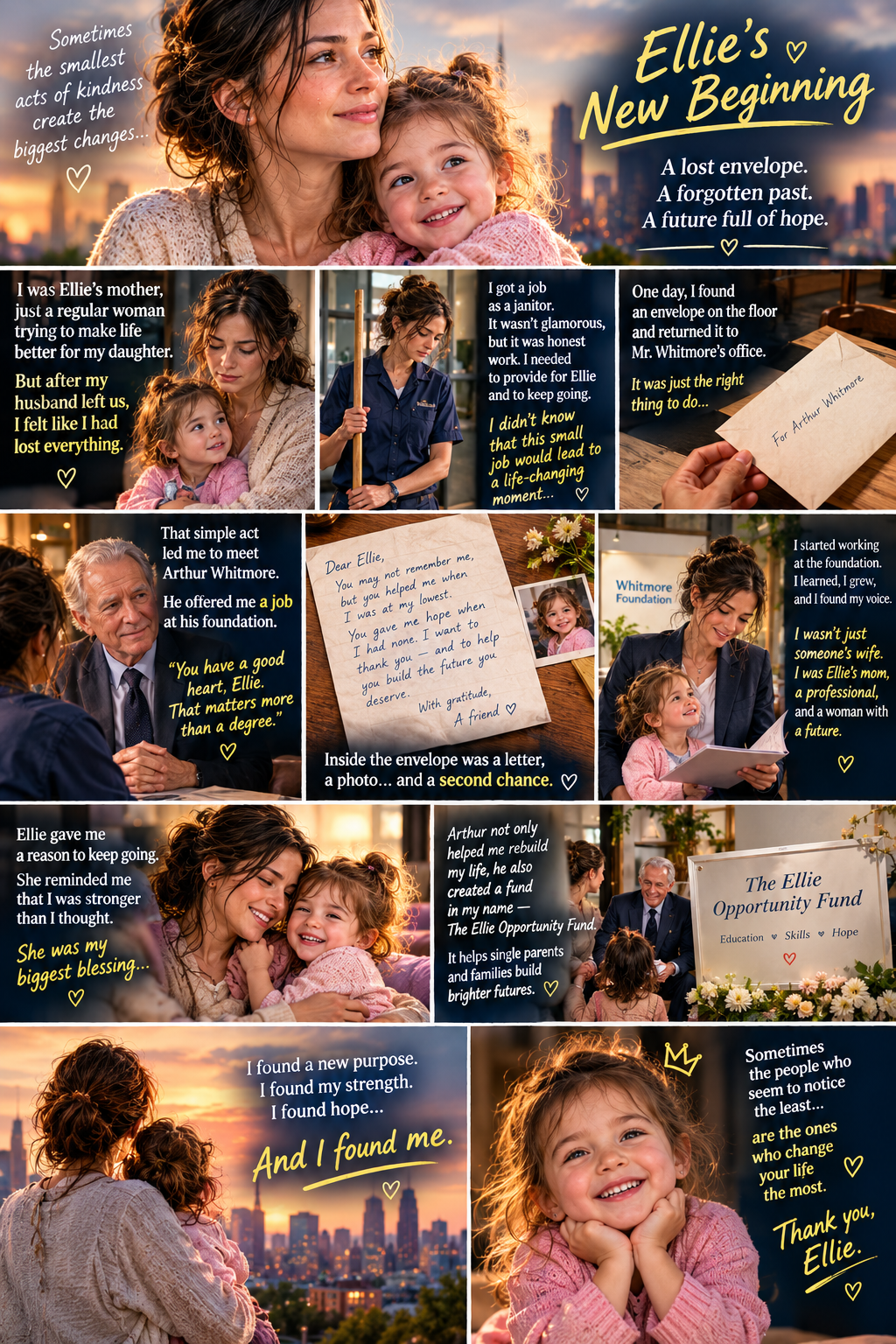
Chapter 1: The Little Girl Who Kept Me Going
My name is Eliana Bennett, but everyone who knows me calls me Ellie.
I was thirty years old when my life fell apart. I had a little daughter named Ellie, a beautiful four-year-old girl with sparkling eyes, rosy cheeks, and a smile that could brighten even my darkest days.
She loved pink dresses, bedtime stories, and the little stuffed rabbit she carried everywhere. Every morning, she climbed into my arms and whispered, “Mommy, are we going to have a happy day today?”
I always smiled.
“Of course, sweetheart. Every day with you is a happy day.”
But sometimes, after she fell asleep, I sat beside her bed and cried quietly.
My husband had left us six months earlier. He said he was tired of struggling financially and wanted a different life. One morning, he packed his belongings, told me he needed space, and walked out of our apartment.
He promised to send money for Ellie.
The money never came.
I tried calling him, but eventually, his number stopped working. His family also stopped answering my messages. The people who had once welcomed me into their home suddenly acted as if Ellie and I no longer existed.
I had rent to pay, groceries to buy, and a little girl who depended on me for everything.
I had no time to give up.
I took whatever honest work I could find. I cleaned offices in the evenings, washed dishes on weekends, and sometimes accepted temporary jobs when other workers were unavailable.
It was exhausting, but whenever I returned home and Ellie ran toward me with her little arms stretched out, I remembered why I kept going.
One night, after I had finished washing her favorite pink dress by hand, Ellie climbed onto my lap.
“Mommy, why do you work so much?”
I brushed her hair away from her forehead.
“Because I want you to have a beautiful future.”
She thought about that for a moment.
“Then when I grow up, I’ll work too, and you can stay home and rest.”
I laughed, but tears filled my eyes.
She was only four years old. She didn’t understand bills, rent, or the fear of not knowing how we would manage the following month.
She only knew that her mother looked tired.
I hugged her tightly.
“You don’t have to worry about Mommy, baby. Your job is to be a little girl, play, learn, and be happy.”
That night, after Ellie fell asleep, I made a promise to myself.
No matter how difficult life became, I would never let my daughter believe she was a burden.
She was my reason to keep moving forward.
She was my hope.
And she was the greatest blessing I had ever received.
Chapter 2: The Job Nobody Wanted
A few weeks later, I found a job as a cleaner at a large office building in the city.
The work began early in the morning and often continued into the evening. I cleaned conference rooms, emptied wastebaskets, polished floors, and made sure the offices were ready for the next working day.
It wasn’t glamorous.
Sometimes, employees walked past me without acknowledging my presence. Others left their coffee cups and papers scattered across their desks, assuming someone else would take care of them.
I didn’t complain.
I needed the income, and I was proud to earn it honestly.
Every payday, I divided my money carefully. Rent came first, followed by food, transportation, and Ellie’s needs. If anything remained, I put it into a small savings envelope hidden in my kitchen drawer.
I dreamed of enrolling Ellie in a good school one day.
I dreamed of giving her a bedroom filled with books and toys.
Most of all, I dreamed of reaching a time when I could stop worrying about whether we would have enough money for the following week.
My supervisor, Mr. Daniel, noticed that I was always punctual and careful.
One afternoon, he found me organizing a stack of misplaced documents in an empty conference room.
“You don’t have to do that,” he said. “Your shift is nearly over.”
“I know, but these papers were scattered across the floor. I thought someone might need them.”
He looked at the organized folders.
“You have a good eye for details.”
I smiled politely.
“I used to help my husband with office paperwork.”
“Really? Have you ever considered administrative work?”
I looked at him in surprise.
“It’s been years since I worked in an office.”
“That doesn’t mean you can’t learn again.”
His words stayed with me.
For the first time in months, I began to imagine that my future might hold something more than exhausting shifts and unpaid bills.
I didn’t know it yet, but a simple act of honesty was about to open a door I never expected.
Chapter 3: The Envelope on the Floor
It happened on a rainy Tuesday evening.
I was cleaning a private conference room on the top floor when I noticed a cream-colored envelope beneath a chair.
It looked different from the ordinary office mail.
My name was written across the front in elegant handwriting.
For Eliana Bennett. Please deliver this to her personally.
I stopped moving.
I hadn’t received a letter from anyone who knew my full name in months.
I picked up the envelope carefully.
There was a return address belonging to the Whitmore Foundation, a charitable organization that supported education, employment training, and families experiencing financial hardship.
I had heard of the foundation because its name appeared on posters around the building.
But I had never contacted it.
I turned the envelope over.
It was sealed.
For a moment, I wondered whether someone had made a mistake. Perhaps the letter belonged to another woman named Eliana Bennett.
Then I remembered something my mother used to tell me.
“If something doesn’t belong to you, don’t pretend it does. And if someone trusts you with something important, respect that trust.”
I carried the envelope directly to the building’s security office.
The guard recorded where I had found it and contacted the foundation using its publicly listed office number. After confirming the instructions, he arranged for the letter to be collected the following morning.
Before leaving work, I asked whether the recipient had been informed.
“They know it’s been found,” the guard assured me. “Thank you for bringing it in.”
I went home feeling relieved.
The letter had nothing to do with me, I thought.
I had simply done the right thing.
But the next morning, when I arrived at work, my supervisor was waiting near the entrance.
“Eliana, there’s someone here who wants to meet you.”
A distinguished elderly gentleman stood beside him.
He wore a charcoal-gray suit and carried a leather briefcase.
“Miss Bennett?” he asked.
“Yes.”
“My name is Arthur Whitmore. I’m the chairman of the Whitmore Foundation.”
He extended his hand.
“I believe you found something that belongs to us.”
I nodded.
“I’m glad it was returned.”
Arthur smiled warmly.
“I would like to thank you personally. But there’s another reason I came.”
He paused.
“May I speak with you for a few minutes?”
I had no idea that saying yes would change the direction of my life.
Chapter 4: The Man Who Saw Something in Me
Arthur invited me to the foundation’s office during my lunch break.
The building was bright and welcoming, with photographs of students, families, and community projects displayed along the walls.
I felt nervous walking into the conference room.
I was wearing my work uniform, and I worried that I might have misunderstood why Arthur wanted to meet me.
He noticed my discomfort.
“Please relax, Eliana. You haven’t done anything wrong.”
I smiled.
“Thank you. I just wasn’t expecting to meet someone like you.”
“Someone like me?”
“Someone who runs an entire foundation.”
Arthur chuckled.
“And I wasn’t expecting to meet someone who would go out of her way to return a letter when nobody was watching.”
He explained that the envelope contained correspondence concerning a scholarship and employment program established by his late wife, Catherine.
The program had been created to help people who were trying to rebuild their lives after difficult circumstances.
Arthur had been reviewing its history because he wanted to expand the program.
Then he asked about me.
I told him about my previous office experience, my husband’s departure, and my struggle to provide for Ellie.
I tried to keep my voice steady, but when I mentioned my daughter, I couldn’t hide the emotion in my voice.
“She’s the reason I keep trying,” I said. “I want her to grow up believing that hard work and kindness matter.”
Arthur listened without interrupting.
Finally, he closed his notebook.
“Eliana, our foundation is looking for an administrative assistant. We need someone organized, trustworthy, and willing to learn.”
I stared at him.
“Are you offering me a job?”
“I’m offering you an interview and a chance to demonstrate what you can do.”
I felt as though the room had suddenly become brighter.
“But I haven’t worked in an office for years.”
“Then we’ll discuss training. You already have something important: a willingness to take responsibility.”
I thanked him several times.
Before I left, Arthur handed me an application and a card with the appointment details.
That afternoon, I returned to my cleaning duties.
Nothing had changed yet.
I still had rent to pay, and Ellie still needed dinner.
But something inside me had shifted.
For the first time, I could see a path toward a different future.
Chapter 5: The Interview That Almost Never Happened
The interview was scheduled for the following Monday.
I spent the weekend preparing.
After Ellie went to bed, I searched through an old box and found my previous résumé. I updated it as carefully as I could, listing my earlier office experience, my organizational skills, and the responsibilities I had managed while supporting my husband’s small business.
My biggest challenge was deciding what to wear.
I had one simple navy-blue dress suitable for an interview. I ironed it carefully and polished my shoes.
On Monday morning, I arranged for a trusted neighbor to watch Ellie for a few hours.
But just as I was about to leave, my daughter developed a fever.
I sat beside her bed, checking on her and holding her little hand.
My heart sank as I looked at the clock.
I couldn’t leave her when she wasn’t feeling well.
I called the foundation and explained the situation, expecting them to cancel the interview.
Instead, Arthur’s assistant told me they could reschedule.
I thanked her, relieved.
Then, an hour later, my neighbor arrived.
She was a retired nurse who had helped care for Ellie before. She offered to stay with her and assured me that she would call if anything changed.
After making sure Ellie was comfortable, I headed to the foundation.
I arrived twenty minutes early.
During the interview, the administrative director asked me about my work history and how I would handle confidential documents.
I answered honestly.
“I believe trust is something you demonstrate through your actions. If I don’t know something, I’ll ask. If I make a mistake, I’ll admit it and work to correct it.”
The director nodded.
Then she gave me a short practical exercise involving filing records and identifying inconsistencies in a set of documents.
I worked carefully, checking each page twice.
When I finished, she reviewed my answers.
“You caught a discrepancy that many applicants miss,” she said.
I smiled nervously.
“I’ve learned that small details can become big problems if nobody pays attention.”
At the end of the interview, Arthur entered the room.
He shook my hand.
“We would like to offer you the position, Eliana. The role includes training, and we believe you have the potential to grow with us.”
I couldn’t speak for a moment.
Then I thanked them.
Outside the building, I called my neighbor.
Ellie was feeling better, and she had been asking when Mommy would come home.
I hurried back to our apartment.
When I opened the door, Ellie ran toward me.
“Mommy!”
I lifted her into my arms.
“Guess what, sweetheart? Mommy got a new job!”
She clapped her hands.
“Does that mean we can have pancakes on Sunday?”
I laughed through my tears.
“Yes, baby. We can have pancakes on Sunday.”
It was a small promise.
But for us, it felt like the beginning of everything.
Chapter 6: The Letter From Catherine
My first weeks at the Whitmore Foundation were challenging.
I had to learn new software, organize digital records, and understand the procedures used to manage grants and scholarships.
There were days when I felt overwhelmed.
Sometimes I wondered whether Arthur had made a mistake in giving me a chance.
But whenever I struggled, someone offered help.
My colleague Maria patiently showed me how to use the database. The administrative director encouraged me to ask questions instead of pretending to understand everything.
Little by little, I became more confident.
One afternoon, while organizing the foundation’s historical records, I discovered a folder labeled Catherine Whitmore — Original Programs.
Inside were photographs, handwritten notes, and letters from families who had received help many years earlier.
One letter caught my attention.
It had been written by a young woman who had received a small educational grant after losing her job.
She described how the money had helped her complete a training course and find work.
At the end, she had written:
“You didn’t solve every problem in my life. You simply gave me enough hope to solve the next one myself.”
I read the sentence several times.
It reminded me of the opportunity Arthur had given me.
Later that afternoon, I showed him the letter.
He smiled sadly.
“My wife believed that people rarely need someone to rescue them completely. Often, they need someone to open a door.”
He told me Catherine had started the foundation after witnessing several hardworking families lose opportunities because they lacked money, connections, or access to training.
“She wanted people to be judged by their potential, not by the worst chapter of their lives,” he explained.
I thought about Ellie.
I wanted her to grow up knowing that people could face hardship without losing their worth.
“I would love to help other mothers someday,” I told him.
Arthur looked at me thoughtfully.
“Then perhaps that’s something we should work toward.”
At that moment, I began to understand that my new job could become more than a way to earn a salary.
It could become a way to help people who were standing where I had once stood.
Chapter 7: The Photograph in the Envelope
Several months passed.
I became more comfortable in my position, and my financial situation gradually improved.
I moved into a brighter apartment with a small bedroom just for Ellie.
We bought a little bookshelf and filled it with children’s stories. I placed colorful curtains in her room and hung her drawings on the wall.
She loved it.
One evening, while sorting the final documents from Catherine’s original program, I found a photograph tucked inside the back of a folder.
It showed a young woman standing outside a community center with a little girl in her arms.
The woman looked familiar.
I turned the photograph over.
On the back were the words:
“Sarah Whitmore and her daughter, 2009. A reminder that every family deserves another chance.”
I recognized Sarah’s name from the foundation’s historical correspondence.
She had been one of Catherine’s earliest scholarship recipients.
According to the notes in the file, Sarah had struggled to support her daughter after losing her job. Catherine had helped her enroll in a professional training program, and Sarah had eventually become a successful educator.
But there was another note.
Sarah had later established a small fund of her own to help young mothers returning to work.
I brought the photograph to Arthur.
He looked at it for a long time.
“Sarah became one of Catherine’s dearest friends,” he said. “She understood what it meant to receive help at the right moment.”
“Do you know where she is now?”
Arthur shook his head.
“We lost touch several years ago. I believe she moved away, but I haven’t heard from her recently.”
I returned the photograph to its folder.
I didn’t know Sarah.
I had never met her.
Yet I felt connected to her story.
She had once been a struggling mother who needed an opportunity. Years later, she had helped others.
Perhaps the kindness that changed one person’s life could travel farther than anyone imagined.
I wondered how many people had been helped by a single decision Catherine made years earlier.
And I wondered whether, one day, Ellie and I might become part of that same chain of kindness.
Chapter 8: The Ellie Opportunity Fund
A year after I joined the foundation, Arthur invited me to attend a board meeting.
The foundation was planning to expand its employment program for single parents and people returning to work after long periods away from the workforce.
The board had already reviewed several proposals.
Arthur asked me to share my experience.
At first, I hesitated.
I was not a senior executive, and I worried that my ideas might seem too simple.
But then I remembered all the mothers I had seen struggling to balance childcare, work, and bills.
I explained that training alone was not always enough.
A parent might qualify for a course but have no affordable childcare. Someone might receive an interview but lack transportation. Another person might have the skills for a job but need help updating a résumé or learning modern office software.
“Sometimes,” I said, “people don’t need someone to make every decision for them. They need practical support that makes the next step possible.”
The board listened carefully.
They asked questions, and I answered as honestly as I could.
Several weeks later, Arthur called me into his office.
“The board has approved a new pilot program,” he said. “It will combine career training, job-search support, and assistance with practical barriers such as transportation and childcare.”
I smiled.
“That’s wonderful.”
“There’s something else. The board has agreed to name the pilot the Ellie Opportunity Fund.”
I stared at him.
“My daughter?”
“Yes. Your story reminded us why this program matters. Your daughter inspired you to keep moving forward, and your experience helped us understand what families actually need.”
I felt tears gathering in my eyes.
“I don’t know what to say.”
“Then don’t say anything yet,” Arthur replied with a gentle smile. “Help us make it work.”
The fund was not a personal gift to me or Ellie. It was a charitable program designed to help families like ours find opportunities and build more stable futures.
Its name honored the little girl who had given me a reason to keep going when I thought I had nothing left.
That evening, I sat beside Ellie on her bed.
“Sweetheart, I have something to tell you.”
She looked up from her picture book.
“What is it, Mommy?”
I explained that the foundation had created a program named after her to help other families.
She thought about that.
“Will it help other mommies?”
“Yes, baby.”
She smiled.
“Then I’m happy.”
I hugged her close.
That was all the recognition I needed.
Chapter 9: A Mother Finds Her Voice
As the Ellie Opportunity Fund began helping its first group of participants, I took on more responsibility.
I coordinated appointments, helped applicants organize their documents, and worked with partner organizations to identify suitable training programs.
I met parents who had lost jobs, people who had spent years caring for sick relatives, and workers who needed new qualifications after their industries changed.
Their stories were different, but many shared the same fear.
They worried that the gap in their résumé would define them forever.
I understood that fear.
One afternoon, a woman named Rebecca came to my office.
She had two children and had been out of paid employment for seven years.
“I don’t think anyone will hire me,” she admitted. “I feel as if I’ve forgotten how to do anything.”
I showed her my own old résumé.
“I thought the same thing when I started here.”
She looked surprised.
“You work at the foundation now.”
“Yes. But I once stood where you’re standing. I was frightened, inexperienced with new technology, and worried that nobody would give me a chance.”
“What changed?”
“Someone gave me an opportunity. Then I worked hard to make the most of it.”
We spent the afternoon reviewing her skills and preparing a plan.
Rebecca enrolled in a training course and eventually found a part-time administrative position.
When she returned to tell me, she was smiling.
“I thought I needed to become a completely different person before anyone would hire me,” she said. “But I just needed to recognize what I could already do and learn the rest.”
I smiled.
“Exactly.”
That evening, I walked home through the city with a feeling of gratitude.
My life wasn’t perfect.
I still had difficult days, unexpected expenses, and worries about the future.
But I no longer felt trapped.
I had learned to ask for help, accept opportunities, and believe that I could develop new skills.
And every time I helped another parent take a step forward, I felt that the hardest period of my life was becoming something meaningful.
Not because the pain had been necessary.
But because I had found a way to build something good after it.
Chapter 10: Ellie Grows Up
Time passed more quickly than I expected.
Ellie started school, learned to read, and developed a love for drawing.
She often sat at the kitchen table making pictures of families, houses, and bright yellow suns.
One day, she drew a picture of me standing beside a large building.
Above us, she wrote in uneven letters:
“MY MOMMY HELPS PEOPLE.”
I placed it on the refrigerator.
It became my favorite picture.
As Ellie grew older, she began asking questions about our past.
She wanted to know why we had moved apartments and why her father wasn’t around very often.
I answered honestly, but carefully.
I told her that adults sometimes make decisions that hurt the people they love. I explained that she was not responsible for those decisions and that she never needed to earn anyone’s affection by being perfect.
Most importantly, I told her that she deserved to be treated with kindness and respect.
One evening, when Ellie was eight, she sat beside me on the sofa.
“Mommy, were you sad when Daddy left?”
I took a breath.
“Yes, sweetheart. I was very sad.”
“Did you think we wouldn’t be okay?”
I held her hand.
“Sometimes I was frightened. I didn’t know exactly what would happen.”
She looked down at her fingers.
“Was it because of me?”
My heart ached.
“No, Ellie. Never. You were never the reason for the problems between your father and me. You were the person who helped me remember why I needed to keep trying.”
She leaned against my shoulder.
“Then I’m glad I was here.”
I kissed the top of her head.
“So am I, baby. So am I.”
That night, after she went to sleep, I returned to the kitchen and looked at the little drawing on the refrigerator.
I realized that the greatest thing I could give Ellie wasn’t an expensive home or a perfect life.
It was the knowledge that hardship did not make her less worthy of love, and that she could always choose kindness without sacrificing her own dignity.
I wanted her to grow up strong.
But I also wanted her to know that she never had to be strong every minute of every day.
She was allowed to ask for help.
She was allowed to make mistakes.
And she was allowed to begin again.
Chapter 11: The Return of a Forgotten Friend
Several years later, the foundation organized a celebration to mark the success of the Ellie Opportunity Fund.
Families who had completed training programs attended with their children. Local employers came to meet potential candidates, and volunteers shared stories about the people they had helped.
I was preparing the registration table when Arthur approached me.
“Eliana, there’s someone I’d like you to meet.”
Standing beside him was a woman in her late thirties.
She had kind eyes and carried a photograph in a small frame.
“Are you Eliana Bennett?” she asked.
“Yes.”
“My name is Sarah Whitmore.”
I immediately recognized her name.
She smiled and showed me the photograph of herself and her daughter that I had discovered years earlier in Catherine’s files.
“I heard about the Ellie Opportunity Fund,” she said. “Arthur told me about the work you’ve been doing. When I learned that your daughter’s name was Ellie, I wanted to meet you.”
I was astonished.
Sarah explained that she had once received help from Catherine when she was struggling to raise her daughter.
That support had allowed her to finish her education and become a teacher.
Years later, she had created her own small scholarship fund.
“I never imagined that the program Catherine started would continue to inspire so many people,” she said. “When I heard your story, I thought about all the women who had helped me along the way.”
I felt a lump in my throat.
“Your story was one of the reasons I believed that kindness could keep moving from one person to another.”
Sarah smiled.
“Then Catherine’s dream is still alive.”
We spent the afternoon talking about our daughters, our work, and the people who had helped us through difficult times.
Before leaving, Sarah handed me a letter.
It was addressed to Ellie.
Inside, Sarah had written about her own childhood, the challenges her mother had faced, and the opportunities that had changed their lives.
She encouraged Ellie to stay curious, treat people fairly, and remember that success meant more than money or status.
At the bottom, she wrote:
“One day, you may help someone you have never met. You may never know how far your kindness travels. Do it anyway.”
I placed the letter in a special box at home.
I knew that one day, when Ellie was old enough to understand the journey we had taken, I would let her read it.
Chapter 12: The Greatest Gift
On Ellie’s tenth birthday, I organized a small celebration at our apartment.
There were balloons, a homemade cake, and a table full of her favorite snacks.
Her friends came over after school, and we played games until the living room was covered in wrapping paper.
When the guests had left, Ellie opened the final present.
It was a scrapbook filled with photographs from our lives.
There were pictures of our first apartment, her first day of school, the little pink dress she had loved as a toddler, and the drawing that still hung on my refrigerator.
At the back was a copy of Sarah’s letter.
Ellie read it slowly.
Then she looked up at me.
“Mommy, why did you put this in my birthday present?”
I sat beside her.
“Because I want you to understand something about our story.”
I told her about the envelope I had found at work, the meeting with Arthur, and the opportunity that had changed our lives.
I explained that the foundation had been built by people who believed that one person’s kindness could help another person find a new beginning.
“And the fund named after you helps families who are trying to build better futures,” I said. “But the most important part isn’t the name. It’s what the program does.”
Ellie looked at the letter again.
“Do you think I can help people too?”
I smiled.
“Absolutely. You don’t have to wait until you’re grown up or rich or famous.”
“What can I do now?”
“You can be kind to someone who’s lonely. You can include a child who feels left out. You can tell the truth when it’s difficult. You can ask for help when someone is treating you badly, and you can stand up for someone who needs support.”
Ellie considered this carefully.
Then she wrapped her arms around me.
“I want to help people like you do, Mommy.”
I hugged her tightly.
“You can find your own way, sweetheart. You don’t have to become me. Just remember to be kind, be brave, and never believe that another person’s opinion decides your worth.”
She rested her head against my shoulder.
For a moment, I thought about the woman I had been years earlier: frightened, exhausted, and unsure how she would provide for her daughter.
I wished I could return to that time and tell her what I knew now.
I would tell her that life could be painful without being finished.
I would tell her that asking for help wasn’t weakness.
And I would tell her that one small act of honesty could lead to an opportunity she could never have planned.
But most of all, I would tell her to keep going.
Not because every hardship would magically disappear.
Not because every person would treat her fairly.
But because her life still held possibilities she could not yet see.
Epilogue: A Future Full of Hope
Years later, I stood beside Ellie as she volunteered at a community event organized by the foundation.
She was older now, confident and thoughtful, with the same bright smile she had carried since childhood.
She helped younger children choose books and sat with a little girl whose mother was attending a job-training session.
I watched Ellie patiently explain a storybook, making funny voices until the little girl began laughing.
Arthur stood beside me.
“She’s grown into a wonderful young woman,” he said.
I smiled.
“She has always had a good heart.”
He nodded toward the children.
“And look how far one envelope has traveled.”
I thought about that rainy Tuesday evening.
I had found a letter on the floor and returned it because it was the right thing to do.
I had not expected a reward.
I had not expected a new career, new friendships, or the chance to help other families.
I certainly had not expected that the little girl I was struggling to raise would one day become part of a story that inspired so many people.
The envelope had opened a door.
But walking through it had required courage, effort, patience, and the willingness to believe that my circumstances could change.
Ellie ran toward me.
“Mommy! The little girl wants to know if she can come back next week!”
I laughed.
“Of course she can.”
Ellie took my hand.
As we walked toward the exit, the evening sun spread golden light across the city.
I realized that I no longer measured our happiness by the apartment we lived in, the money in our savings account, or the approval of people who had once walked away.
Our lives were not perfect.
They were something better: honest, meaningful, and full of possibilities.
I had started out believing that I needed to save Ellie from a difficult life.
In the end, she had helped me rediscover my own strength.
She reminded me that love could exist alongside uncertainty, that kindness could create opportunities, and that the future was not determined by the person who abandoned us.
It was shaped by the choices we made afterward.
I kissed her forehead.
“Are you happy, sweetheart?”
Ellie smiled.
“I’m happy because we’re together.”
I held her hand a little tighter.
And in that moment, I understood the truth I wished every struggling parent could hear:
Sometimes, the greatest gift a child gives a parent is not a reason to be perfect, but a reason to keep believing in tomorrow.
I had lost a marriage.
I had lost the future I once imagined.
But I had found a new purpose, a community that believed in me, and a daughter who taught me that even the smallest acts of kindness could create extraordinary change.
And it all began with one envelope that someone had forgotten.
The End. ❤️
The moral of Ellie’s story
Never underestimate an ordinary person, an honest decision, or a small act of kindness. You may never know how much your actions matter to someone else.
And if life forces you to begin again, remember this: you are not defined by who left you behind. You are defined by the courage, kindness, and hope with which you build what comes next.